A memoir of love, loss, and hope
Writing by Noam Miron & Artwork by Ariella Charny
סיפור על אהבה, אובדן ותקווה
כתיבה: נועם מירון, איור: אריאלה צ'רני
Tutti's Story
It feels strange to call this “Tutti’s Story”
She never got to live her life, and will never have the chance to tell her story.
It’s a story with no beginning, and no end.
Where does this story start? At conception? When exactly does a cluster of cells become a living being? Obviously, it's a gradual process, not one defined moment. When did Tutti become Tutti? What are the milestones in Tutti’s story? Ultrasounds, amniocentesis, all these tests - none of their dates are etched in anyone’s memory. Analogous to graduation, a first job or a significant trip. The dates of the big moments in her life, set by someone else, which no one remembers.
There’s a “birth” date. There’s a burial date.
But there’s no date of death.
All we know is, it happened in reverse.
First Death. Then Birth.
Tutti’s story, Maya’s story, became our story. Our family’s story.
A story that only we can tell.
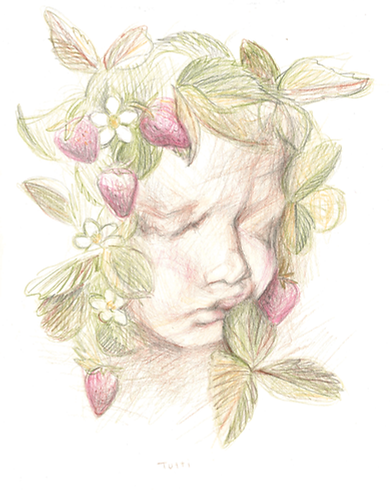

No Birth, No Stillness
What a terrible term: "Stillbirth." So many things can define that day, stillness is definitely not one of them. Perhaps the stillness wasn't there for us because we have never heard a newborn baby’s first cry, Tutti being our first child.
Instead, we cried ourselves.
The word birth stabs at our aching hearts. It implies life, beginnings, hope. But all we had was death. An ending. Few things in life are as final as death.
In Hebrew, there is no term to describe what we went through that day without saying "birth," while in English, there’s "labor and delivery," a mechanical phrase, sterile, gray, no emotional weight. It only refers to the physical act of bringing a fetus out of the womb.
There was no birth. And there was no stillness. Our baby died, then came out into the world. Lifeless.
Faced with this impossible task of telling people what happened, the simplest way is to say we had a stillbirth. But how do you explain what we experienced? Our lives have changed. They will never be the same. On the outside it looks almost the same, sleeping, eating, working, even laughing and smiling. But on the inside, it's a whole different world. Tutti will always be with us.
The World Broke
How the hell did this happen? This defies all odds.
Umbilical cord complications at 40 weeks are so rare, there’s no real data.
The literature mentions it occasionally as late term IUFD, but there’s not enough data to understand the probability this could happen so late.
We live by statistics. What are the odds of being struck by lightning? Of a plane crash? An earthquake? A missile landing on our house? Aliens showing up like in a dystopian movie? Winning the lottery? These things don’t happen. I mean, they do, to someone, somewhere. But not really. Not to you. And then something happened to us, something that doesn’t actually happen.
So how do you trust again? What’s true? What’s false? Why shouldn’t it happen again?
The logic we built our lives on, completely shattered. The world broke.


We Wanted...
We wanted to bring life. We brought death.
We wanted joy and love, for us and our whole family.
Instead, we unleashed depression.
We wanted to be admitted into the maternity ward,
but within hours, we were talking about cemeteries.
We wanted to send out happy pictures, holding Maya in our arms.
Instead, we asked close friends to break the news to the rest.
We started with womb, but ended with tomb.
We wanted sleepless nights caring for her.
Now our whole family lies awake at night, worrying about us.
We wanted to return home with arms full, as a family.
We came home empty-handed, as a couple.
We wanted...
The Tragedy
About a week before everything happened, I was at the cemetery in Holon, burying my father’s aunt. It’s always sad to bury someone, even at age 94. I could have never imagined that only five days later, I’d get the devastating news that I will have to return to the same cemetery, to bury my own daughter.
What a cosmic contrast. One woman lived a full life. Another, 94 years younger, didn’t get a chance to make her mark on the world. She didn’t get to feel anything, to hear her own voice, or to fill her lungs with her first breath.
The world lost Tutti. We lost her. And Tutti lost herself. People might say we’re the ones to be pitied. They’re wrong. Tutti is the one to pity. Her entire world broke, never to be whole again. We’ll eventually rise from this grief, live with the pain, smile again, laugh, and experience joy. But Tutti will never have that.
All we’re left with is imagination. What would her voice have sounded like? What would she say? How would she have made the world better? In our minds, we feed her, change her diapers, walk her to preschool. We imagine her lifelong friendships forming. We picture vacations together, sandcastles, beach waves, ski slopes, her laughter echoing through it all.
Then, we imagine the next child. Tutti’s little sister. Suddenly we notice that those images stay the same. Her sister looks and acts the same. Because how can we separate them now? How can we not project Tutti onto her little sister?
That’s the essence of the tragedy: No one will ever know who Tutti really was.


Fatherhood Blitz
From the very beginning of the pregnancy, I told Ariella, “You’re already a mom. I’m just waiting to become a dad." She felt it every moment of the day. Deciding what to eat, on which side to sleep. Later in the pregnancy, she felt Tutti’s kicks. Their souls began to bond. I only had logic: "This is happening." A mere voice in my heart. I would meet Tutti briefly during ultrasounds, or when I felt a sudden kick under Ariella’s skin. But I knew, once Tutti arrived, I’d become a dad.
Then came the phone call. "Noam…there’s no heartbeat. Come now!" Ariella’s voice, crying, hysterical. My heart dropped. I couldn't believe it. I didn't understand. I thought I’d get to the hospital, the doctors would calm me down, say we'll take care of it, maybe labor was just starting early. I canceled a work meeting, jumped on my bike, and rushed to the hospital. I called her again. Her voice was so quiet. Broken. She said, “Nothing can be done.”
But I shouted, begged the doctors to check again, begged for an emergency surgery, anything to save Tutti. I stormed into the hospital. Asked the nurse where room 6 was. Her face fell, as she pointed silently. I entered, collapsed into Ariella’s arms, and we cried together. My first time crying in over 15 years.
Then came the labor induction process. Over 50 hours. Some of the hardest hours in our lives. 50 hours where all my thoughts revolved around Tutti. Who she was, what she looked like, sounded like, could have been. Just one thing consumed me, my daughter, Tutti. This amazing girl, full of potential, made from my own DNA combined with that of the person I love most. When you lose something, that’s when you realize fully how much you loved it. That's the bizarre psychology of humans.
Most parents fall in love with their baby while getting to know them. Our fate is to love her, without ever knowing her.
Just over 50 hours passed from what started as the “routine 40 week check-up” to holding a dead body in my arms for the first time in my life. And it was my daughter’s dead body. I simultaneously held her for both the first and last time. Over 50 hours of being a dad in the most intense, raw, heartbreaking way possible.
I went through a fatherhood blitz. The gap with Ariella is closing. From here on, we’ll keep walking this strange, symmetric path of parenting, for our little angel.
A Story Full of Gaps
This story is full of gaps. We don’t know why she got entangled in the umbilical cord at 40 weeks. We don’t know when. It just happened.
The doctors say it wasn’t the inversion. Couldn’t be. The doctors say it wasn’t Spinning Babies. Couldn't be. They begged us not to blame ourselves. But once something virtually impossible happens to you, you start believing in every tiny, improbable chance that they might actually be wrong this time. That it's somehow your fault.
A story full of gaps...and nobody likes having gaps in their stories. We now have a free hand, so we fill the gaps however we like. Naturally, our brains fill them in the most human way possible, with ourselves as the protagonists. We immediately think about all the moments where we could’ve acted differently, changed our fate, and brought her into this world alive.
So we do it. The gaps are filled. The story is complete.
Only one question remains: What do we do with the guilt? Do we analyze it, one feeling at a time, hoping it’ll one day fade? Or try to avoid it, attempt to let it go?
How do we accept the gaps?


Mom & Dad Are Born
Who are we now? Are we parents?
If so, where are our kids?
What makes us parents if we’ve never held our baby and looked into her big, innocent eyes? We didn’t rock her to sleep, didn't bathe her, didn’t get up in the middle of the night for her.
And yet, there is one girl, one baby girl in the universe, and we’re her parents. She came lifeless into our world. But she's our daughter, and we're her mother and father.
That day, no baby was born. Only parents.
I imagine ourselves in ten years, with two or three living kids. Someone will casually ask, “How many children do you have?” I don’t know how we’ll choose to answer. But I know that deep inside my heart, I’ll have a different answer.
Life in Different Dimension
She lived her life in a different dimension. A parallel world. A strange one, where people float in a warm tub, free to twist, turn, kick, no one telling them no. A world where you don’t breathe, eat, or speak, just receive everything through a cord plugged into your belly button.
From Tutti’s perspective, only she exists there, and there’s no one like her. Her only communication was with beings from a different dimension, those odd people who breathe air, eat food, talk politics…Bizarrely, she was inside one of them, in Ariella. Her entire existence was within that strange world. She never met any friends like herself.
Communication in that world is strange and direction-dependent. She receives signals via soft caresses, muffled voices and or a light show that passes through that thin wall between universes we sometimes call a womb. Her only way to respond? Kicks that form tiny hills on Ariella’s belly.
What a strange world to live in. We’ve all been there. We’ve all emerged from that warm dimension into this one.
But Tutti didn’t make it.
Well, let’s be accurate. Her body arrived, but only after her soul had already moved on, into a new, other, unknown dimension.

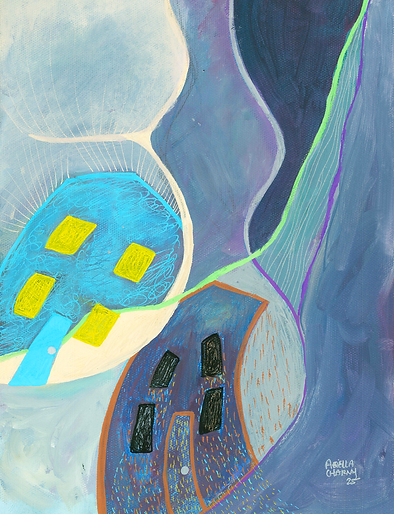
A Big, Empty House
We came back from the hospital and sat down on the far side of the couch in the corner of the living room. The house felt huge. So much space. Space where Maya was supposed to crawl, play, laugh. The clean couches, which we expected to be stained with her messes, remind us of her absence.
The “safe room” was full of baby gear. A baby car seat that expires in 15 months. Formula. Diapers. I opened the closet, saw a tiny onesie labeled “My First Outfit.” Next to it, an ultrasound picture of Tutti. Now we had to put it all away. Where to? In Boxes? At my parents’ place? The changing table is bolted to the wall. Every featherlight item demands so much energy to move. And worse, those that expire need to be sold. How do you even start?
It took Ariella weeks to build the courage to even look inside the room, and only after I cleaned and rearranged everything I could. Before that, we left an eye mask on the door handle, so she could cover her eyes during the sirens warning about missiles coming from Yemen. I didn’t want her facing two traumas at once. So that she could at least breathe.
Same two people, same two cats, same house as before.
But now it feels big. Empty. Foreign.
The Day After
The day after the stillbirth, in the hospital, I opened a blank notebook and started writing. This is the way I started:
"I'm afraid. Afraid that I'll get back to routine too quickly. That I won't get to actually mourn."
Then I continued for 1,300 words. Here are parts of it:
“People want to pull me out of this, and that’s okay. It’s probably what I would’ve done too. But I need to talk about what happened. We can’t just have small talk as if nothing’s changed. And if I already feel this way now, what will it be like later? The memory will fade. I won’t be able to recall it, or feel it again. And it’s so important to feel. Why is it so important? Right now, I don’t know why, but I do know it matters, and I don’t know how to do it. I did manage to cry. I actually cried! That, to me, is a win, as weird as it sounds. It felt strange, hearing myself cry. It hadn’t happened in so many years."

“I told Ariella that we each have opposite challenges. Her challenge is not to drown in grief. To get up and somehow continue. My challenge is different. How do I make sure I don’t move on too fast? How do I keep this moment with me? And I’m afraid that'll drift us apart. That I won’t be able to emotionally connect to her. That my support won't rise from a deep place of empathy, and I’ll answer robotically; ‘It’s fine. We’ll be okay. Our love will overcome any obstacle. We’ll have adorable healthy kids someday.'
“It’s as if I want these days to change who I am. I was ready for my fate to change...Now the default is to go back to routine, as if nothing happened. But I was ready to be transformed by this little girl we were going to raise. And now that she’s not here, maybe my subconscious is still trying to create a deep internal change anyway?”
I want to cling to this moment because otherwise, it’ll slip away. And I won’t change. But I already saw the change. I cried! That’s incredible! Sad, but incredible. We cried together. We were so in sync in our grief. It felt so right. Maybe that's a better word than incredible. I felt right."
"This journaling helped. I surprised myself.”

Her Cry, Her Cry, My Cry
All we wanted was a crying baby. The sound of crying suddenly became the most beautiful and heart-wrenching sound in the world to us. We yearn for the next pregnancy, hoping it concludes with a crying baby, who won’t stop crying. We’ll all be overjoyed.
But for now, we cry.
Crying is a trigger. It pierces the soul. It triggers that “fight or flight” switch. Your entire being wants to make the crying stop. That’s why babies cry, it’s designed to make us act.
But when Ariella cries, I get into character. I brace myself, and step into it. I remind myself: I need to resist that physiological urge to make the crying stop. I need to be there for her. I give her my shoulder to cry on. I let the crying continue as long as it needs. I tell her there’s space for it, that these feelings, these impossible feelings, are nothing but a natural response to an unnatural situation.
She asks impossible questions. "Why did this happen to us? How can we make sure it never happens again? Why isn’t there a standard protocol to induce labor at 38 weeks? That could save lives!" These questions stab me like knives. I want to answer. But I don’t have the tools. No one does. So I tell her: “I don’t know. But I do know this: I love you. You are the best thing that’s ever happened to me.”
And then she says I’m amazing and supportive, and she asks how she can support me. And all I can think is: “Please stop crying.” But I can’t say that. It contradicts everything I just told her. So I go silent, and say: “I don’t know.”
I care for Ariella like she’s my baby. And what about my own crying? There’s no room for it. There’s enough crying in this house already. I cried at the hospital. At the burial. I cried well and hard. But that was it. My crying was buried, alongside my daughter.
One Day
Maya was a healthy, fully developed baby who died in an accident. If she had died the day after she was born, and not the day before, suddenly everyone would have understood us. But because of the 1-2 day difference, people treat it like a miscarriage. So no! It's not a miscarriage. The pregnancy was perfect throughout, and reached the end-point. The pregnancy was complete, with a mature healthy baby ready for this world.
All that was left was for our baby to arrive alive.
How's Ariella?
We live in a sexist world. There’s discrimination against women, no doubt. But in this case, the discrimination is against men.
I truly appreciate the Israeli law for giving women full 15 weeks maternity leave, whether or not the baby lives. But what about the father? 3-5 days. And only using vacation/sick days, or unpaid leave. Amazing, isn’t it? I lost my daughter! The bare minimum I should get is a proper bereavement leave (7 days), which is also light years away from enough.
About a week after our baby lifelessly entered this world, Ariella got a call from the healthcare provider, offering her psychological therapy sessions covered by insurance. Calling me? Not on their radar. I had to reach out myself, inform them I endured a “stillbirth at 40 weeks,” and ask for psychological support.

After waiting weeks for a referral and approval, they scheduled a preliminary consultation, in three months. Only after that would I be matched with a therapist. Seriously!?
Sometimes I find myself having to tell someone new about what happened. Often the very first question is: “How’s Ariella?” They look at me, and I guess I seem fine. There’s nothing written on my forehead announcing my mental state. In their mind, Ariella must be the broken one, so they ask about her. And they keep asking. “Does she have what she needs?”
Too few are those who were able to ask if I’m okay. To acknowledge directly that I too am going through something hellish. That there isn’t an hour in the day when I don’t imagine myself holding Tutti, tossing her into the air, hearing her giggling as she comes back into my arms. Or maybe as she floats, slowly disappearing, never coming back to me at all.
So next time were speaking, please remember that Tutti has both a mom and a dad.

How Are You?
Take a moment to think about what you’re asking. Usually, the question, “how are you?” is automatic, rhetoric. It’s a question asked to be polite, and answered without thinking: “Fine, thank you.” Usually it’s asked face-to-face, maybe accompanied with a hug. Sometimes it doesn’t even get an answer, it’s just a social reflex.
But now, it’s different. We are not fine. Our daughter died.
People care and want to show it. They send us messages. But it’s not like asking “whats up” before a hug. This time, it’s a text message. Often after some time we didn’t speak. This time, it’s not rhetorical. It’s asking for an update.
But how are we supposed to answer? “Terrible. Our baby died. How about you?” Or should we go with the usual “fine,” as if that helps anyone?
So what’s the purpose of the question?
The situation is painfully complicated and it is impossible to write a real answer in one line. And if it is not in one line, then you have to write an essay that's not suitable for text. When we meet, or in a phone call - we can talk about it in depth.
So let's say you want to help us and don't know how. There are many questions you can ask, even in text, for example: What did we do today? Try to set up a time for a conversation/meeting. You could perhaps send a few words of encouragement, say that we are courageously dealing with an impossible situation. You can just send a heart or send a meal, say that you're thinking of us, without starting a conversation. It also helps. It warms the heart to know that you're thinking of us. It could be best to just talk on the phone or in person, and to be willing to talk about grief, and not offer "solutions."
Some words can hurt. We've heard statements like: "Time heals," "There will be more children, this is just a hurdle in the way," "It's all from above," "Baby steps," or worst of all: "It's all for the best, everything happens for a reason." We've also heard tactless questions like "Did it happen because of something you did?" "Is it because of the inversion?" "You're still having trouble sleeping at night?" "Do you feel guilty?” "What do you even do all day?"
To be honest, even people in a similar situation to ours may react differently. Even Ariella and I are different in this.
The best thing is to gently ask what is good for us. If you are willing to talk in depth, be prepared for a difficult conversation, and to speak from the heart. Start by asking: "I really want to be there for you and support you, but I don't know how." It's true that it may be hard for us to help you be there for us. But it shows vulnerability, and invites a conversation and true connection. Do it again, and again, and please don't give up.
Helping Helping
Our friends genuinely want to help. They want to comfort us. But they also don’t know how. And that creates anxiety. Fear of saying the wrong thing.
The fear sneakily takes over the sub-conscious: They say to themselves: “They probably need space,” They justify staying away. But what we feel is isolation.
Talk to us! Be there! Ask! Maybe we actually do need space. But then ask again later if we still need it.
Don't let us feel alone.
Because we feel alone.
In the midst of grief, in the fog, during one of the most difficult times we've known, we feel alone. What do we do with all this space?
Many dear friends do initiate. Usually suggesting to come over and bring food, or meet in a cafe or a bar, in an attempt to laugh a little and lighten the atmosphere.
But enough with the lightness! I'm tired of ignoring the real things. Say something real. Show me that you're hurting with me. I understand that it's hard. It's really scary to enter into the horror of pain, loss, grief and emptiness. Why would anyone want to put themselves in that situation?

Some try to relate. They tell us of a case they heard of that may be similar, or even something that happened to them. Maybe a miscarriage at week 8. But if you didn't live through a stillbirth, you can't fully empathize. So just be with us in our story. Ask. And respond, because there's no point in talking to a wall. Share your feelings. Show vulnerability. We understand that it's complicated, but it's better to try and stumble and show that you care, than to not say anything at all. We understand and forgive easily.
Now and then friends shed tears with us, especially the first time we tell them what happened. But they usually don't ask questions. They listen in silence, the kind of silence that echoes my own words in my head. Usually the conversation then continues to something mundane. After that tearful encounter, we might not hear from them for a while. Is it our job to chase them? To ask our friends to be with us in our pain?
One day I had a realizaiton. I worked up the courage and told a close friend: “Man, I feel alone." A terrible statement. Deep inside, it felt like I was saying: “You failed me as a friend.” I stabbed myself in the heart. Because he didn’t fail! He didn’t understand, how could he? To him, Maya was abstract. He didn’t even have a photo of her in his mind. He said he imagined our situation as somewhere between a miscarriage and a mother losing a child in the war. I don't like those comparisons, charting pain and grief in a graph. To help him understand, I gave him an example: “Imagine your own infant daughter didn’t God forbid wake up tomorrow.” Again I stabbed myself in the heart. This time, it was a double edged dagger, and he was stabbed too. We sat there on the beach, looking into each others’ eyes, with a phantom knife stuck between us. Thank God I have such good friends that I can be that brutally honest with.
It helped him understand. I just hope it was worth the pain it took to get there.
Since then, things have become clearer to me: People want to help. It's our job to find the strength to help them help us.
The Old Surgeon
Everything is drenched in grief and exhaustion. Without sleeping pills, sleep is impossible. It’s hard to fall asleep, even harder to get up. Tired all day. Each day dragging into the next. Everything feels meaningless. Work? One way or another, it’ll be fine. Who cares anymore? No energy to stand up for myself, to push, to build anything. Whatever comes our way, we take it as it is. We surrender. The world slaps us in the face, and we just take it.
A few weeks after we lost Maya, Ariella had a dermatology appointment. The doctor recommended removing a few moles. We didn’t like the doctor. But who has the willpower to look for another opinion? So we let them book an appointment to remove them. The surgeon was old and grumpy. We didn’t ask questions. He did a rough job. Left large scars. But who cares? What do physical appearance even matter now, or ever?
There’s only one wound that matters: The one in our hearts. And no one can see it. I wish they could. I wish we could show it, and be understood instantly. No words would be needed. I wish all the scars were meaningless, like the marks left by the old surgeon.

Swiftly and in a Stroller
Suddenly, we have time.
We go on morning walks at 11 a.m. We stare out at the ocean, our eyes vacant. The sea never stops. The sky is blue, the grass is green. And the strollers are everywhere. Were there always this many strollers? Or did we just never stroll through the city in the middle of a weekday? Maybe we’re just extra sensitive now, and every baby, stroller, or carrier feels like an attack. It’s probably a bit of all three.
One thing is certain: We’re trapped. We’re not the kind of people who can stay indoors all day. We need air. We need daylight. But where do we go? Parks, trails, beaches, cafes - all swarming with strollers. Do we just stay home, in our cave, and come out only in the dark like vampires?
Despite the strollers, we still try to catch the sunset. We’ve always loved sunsets. But now, sunsets are extra special to us because remind us of Tutti. We wrote on her gravestone: “The most beautiful sunsets are gone before you get to know them.” Yet each sunset also brings us a sliver of hope, being one day closer to building a family again.
But are we even capable? How will the next pregnancy feel? Will it be drenched in endless fear and anxiety? What if fate will turn against us? How will we cope if there is a problem, God forbid? So we just wish, pray, beg, that one day, soon, we’ll be the ones with the stroller.
Swiftly, in a stroller, in the near future.*
*Swiftly and in the near future, בעגלא ובזמן קריב, comes from Jewish prayers (including the Mourner’s Kaddish). The phrase offers a play on words, for it also sounds like, “in a chariot/stroller, and in the near future.”
With Arms Full
We went through this pregnancy alongside seven other pairs of friends. Some close, some closer. All of them, expecting their first child. These seven pregnancies follow in the footsteps of other close friends that recently had healthy babies.
We were thrilled. We dreamed how our kids would grow up together. Friends from birth, sharing adventures all over the world. We imagined our own friendships living on into the next generation.
But now, the others keep going forward, in the path they had paved for themselves. They gave birth to living babies, and we’re left behind. They came home with arms full. We came home with eyes full of tears. There’s a quiet reverence that we feel toward them, like they passed a test that we failed. It feels strange that for everyone else, the default is a healthy, living baby. In the US, it’s common to throw baby showers weeks before the due date, as if it’s all guaranteed. We waited nine full months for Tutti, and ended up returning home, alone, heads down, empty handed. And now we have to start over.
Deep inside, we’re so happy for them. But the incessant pain crashes over us simultaneously. The tears come fast. Why can’t we celebrate with them? How did we veer off course? Why is it pain that we feel when getting the news about a live newborn baby? Can we ever go back to being happy like we were? When will we stop crying every time we see a baby? When will we be able to face our friends and family with their babies and children, instead of asking them to get a babysitter? When will we be able to stop pulling away from the people we love? When will we no longer be this childless couple, that everyone pities? After all this distancing, will they even take us back?
When will we make the journey home from the hospital, with arms full?

Holidays & Seasons
Passover arrived just a few weeks after Maya died. Only days after her burial. We thought we could handle it. Thought we could sit at the Holiday Seder table with my brother and his adorable little daughter.
But once we sat down, Ariella broke. “She’s so small and sweet,” she cried to me. “Just like Maya was supposed to be.” She left the table.
Later, my brother offered to step out and visit his in-laws who lived nearby. Ariella and I cried, and talked. What helped me in that moment was realizing: We had a choice. A choice between two kinds of pain: Sitting with the void of not having my brother and his family at the table. Or facing the storm of emotions that their presence stirred up.
With Tutti, we had no choice. Now we did. And that power, to choose, strengthened me.

So we decided: Ask them to stay. Let’s be together. We returned to the table, but they were already gone. They had decided for us. They saw the pain and wanted to help. They meant well. They love us. They wanted to ease our burden. They couldn’t have known that in that exact moment, what we needed most was the power to decide. That’s where we stumbled. We try to get up an keep going forward, but time swirls between past, present, and future, and feeling powerless. And we, powerless, are spinning with it.*
*The words holidays and seasons in Hebrew, חגים ומועדים, offer a play on words, for they can also be translated as "spinning" and "stumbling."
Friends
Who are our friends? Most of our friends are fresh parents, and we have a hard time being around their babies. So, maybe we'll look for young couples without children, because that could be easier. But they don't even understand what being a parent feels like. Do I even know what it feels like? So it seems, I don't belong. I'm neither here nor there. Both father, and not father.

Songs & Portals
Sometimes I hear a song, and it opens a portal to a completely different world. The lyrics lose their original meaning, and suddenly they’re about something else entirely.
An example:
Shalom Aleichem (a traditional Sabbath song).
It has four parts, and they are all identical except for the first word (in Hebrew), as following:
"Peace be upon you, angels of peace…
Come in peace, angels of peace...
Bless me with peace, angels of peace...
Go in peace, angels of peace…"
Tutti, our little angel.
She came, she blessed us, and she left in peace.
The Opposite
A classic nightmare. You're free-falling. But not like in the cartoons, where you bump into branches and ledges along the way. No. A free fall, straight down, nothing to break your descent.
Then, boom!
You wake up in a sweat. Your heart is racing. You tell yourself, “It was just a dream. Everything’s okay.”
But for us, it’s the opposite.
At night we dream that reality is just a nightmare, and didn't really happen.
And then morning comes, and we realize.
This is real.


Signs of Healing
A sign of healing: We asked our friends how they were doing, and we meant it!
Not just to change the subject, not just to seem “normal.” But because we genuinely care.
Everyone carries something. Everyone feels the weight of their baggage. We just have a massive new boulder in our bags, one that will never come out. We’ll grow stronger, but we’ll always carry it. Hopefully, we’ll get strong enough to help others carry theirs too.
That’s healing.
This Is For Life
We got tattoos of a strawberry plant. (Tutti means my strawberry in Hebrew.)
An active step in our rehabilitation process.
We were afraid.
Are we brave enough? Won't it just remind us of Tutti and fill us with sorrow every time we look at it? How will it affect intimacy? How will we explain it to strangers? But we decided to do it, for it felt right. What's the worst that could happen? After all, the worst had already happened.
The tattoo isn't meant to remind us of her. For she will always be a part of us, with or without the tattoo.
Every future thought, smile, dance or laugh will carry with it a memory of her, sorrow for what she is not, and dreams of who she could have become.
She will be present in every part of our body, from the depths of our soul, to the outermost layer of our skin.
Just as a tattoo is essentially a collection of individual dots that together make up a complete picture, so too are my thoughts about it:

-
We all carry baggage as we go through life’s endeavors. Some get engraved in the heart. Others are left as scars on the skin. The tattoo, however, is a scar we chose. This decision is an expression of control. But in the moment of truth, when the needle pierces the skin, there is also complete surrender to the artist. This is another layer in the never-ending maturation process, in which we learn where to try to control, and where to let go. After loss, we need to let go, accept the lack of control. Accept the fact that we could not have saved her.
-
The tattoo is hand-drawn. Imperfect. Human. Ariella’s and mine are based on the same sketch, but are in different locations on our bodies, with different shading and emphases. We went through the same event, the same trauma, but each in our own way.
-
When the needle stuck our skin, we both thought of Tutti. The physical pain seemed to blend with heartache. Was the needle permanently injecting the pain into our bodies? Or, rather, was it transforming it, allowing it to move through us?
-
The tattoo symbolizes the directionality of time. We cannot go back. Feelings of guilt are unhelpful, and we must look forward. We will never be the same - and that's ok.
-
Everything is temporary. Everything has an end. Just as Tutti’s death is final, so is the tattoo. Just as Tutti’s life was temporary, so is the tattoo, as it only lasts a lifetime.
I wish we didn't have to get the tattoo. We didn't get it to beautify our bodies. But if it makes us feel beautiful and empowered - then that's a win. How beautiful is it that Tutti, even now, can make us feel good and love ourselves. That we can grow stronger as a couple, connecting even more with one another, thanks to Tutti. We wanted to give Tutti a lifetime of happiness. Now, there is very little we could give her. We gave her a name, and a proper burial. With the tattoo, we give her a place in this world. A voice. Some ability to make an impact, and to accompany us wherever we go. For when we give to her, we of course receive in return.
We wanted to give her everything throughout her life. Having a daughter - thats for life.

A Circular Marathon
Imagine an official marathon. The runners are approaching the finish line. One runner, just a few steps away from it, collapses. He lifts his head, looks at the finish line, but can’t get up. Around him, some runners continue and finish the race. Others stop, offer a hand, but they hesitate. They’re afraid of getting too close, of ending up on the ground too. So they let go and keep running toward the finish line. Eventually, that runner manages to recuperate. He looks ahead, but the finish line is gone. In its place, is a new starting line.
Now he has to find the strength to hobble toward the start line, which appears to be farther than ever.
Once he gets there, he has to start running again.
The Young Couple
A young couple is sitting at a bar. They are talking about their experiences on an outdoor adventure. A waiter comes over and asks what they would like to drink. The couple politely declines, and orders tea. Surprised by the young couple, the waiter returns to the kitchen. Unaware that the couple is no longer that young, and that they're not really just a couple. That they arrived without their daughter, and will also return home and go to bed without her. And so the waiter thinks to himself, what is strange about this couple? Because they look exactly like all the other young couples.
The Pouch
It's a lonely world out there.
People don't understand that not every late-term pregnancy concludes with a living baby in your arms.
Months later, and Ariella is still walking around with a little "pouch." Her stomach is still not as flat as it used to be. After normal births, it would have been a badge of honor, a reminder of having gone through a pregnancy “successfully” and having a happy, healthy baby girl at home. But today, it's a badge of sorrow. A pouch yet no baby.
Strangers, tactless, repeatedly ask Ariella about her belly. "Is this your first pregnancy?" "Oh, we must be around the same time, I'm week 20!" And sweet Ariella doesn't want them to feel bad, and merely says "No, I already gave birth," a response that of course is followed by a "Mazal Tov!" Somehow, it's only women who proclaim another’s pregnancy with such confidence.
Following such encounters, Ariella will come home broken and tearful. Praying for her pouch to be filled with a baby, before her stomach gets flat again.
I tell her, all we need is patience and faith, we already have everything else.


ABC
It’s a isolating feeling when everyone seems to keep having kids, and we’re just...not. That feeling has to be changed somehow. I guess there is no better way than to try to bring Maya’s little siblings into the world.
Of course, it’s going to be a pregnancy filled with endless anxiety, automatically labeled as high-risk, filled with many more scans and tests, just to reassure ourselves that everything’s okay. So we can breathe...at least until the next appointment.
And after the next baby? The biological clock keeps ticking. We’ll keep wanting to “catch up.”
So our ABC is choosing life. Choosing to get pregnant, again and again and again. The years where everything we do revolves around pregnancy and, we hope, birth.
So I tell Ariella that she is my ABC: My “Accordion Belly Cutie.”
For Tutti, forever in our hearts.

Maternity Photoshoot, January 2025. Photo by Boris Chernykov

Our Strawberry Tattoos, May 2025. By Or Hagay